The Aquarium
Listen to Chapter 1
The Aquarium · Full cast audiobook
Listen to the story while you read. Your position is saved on this device.
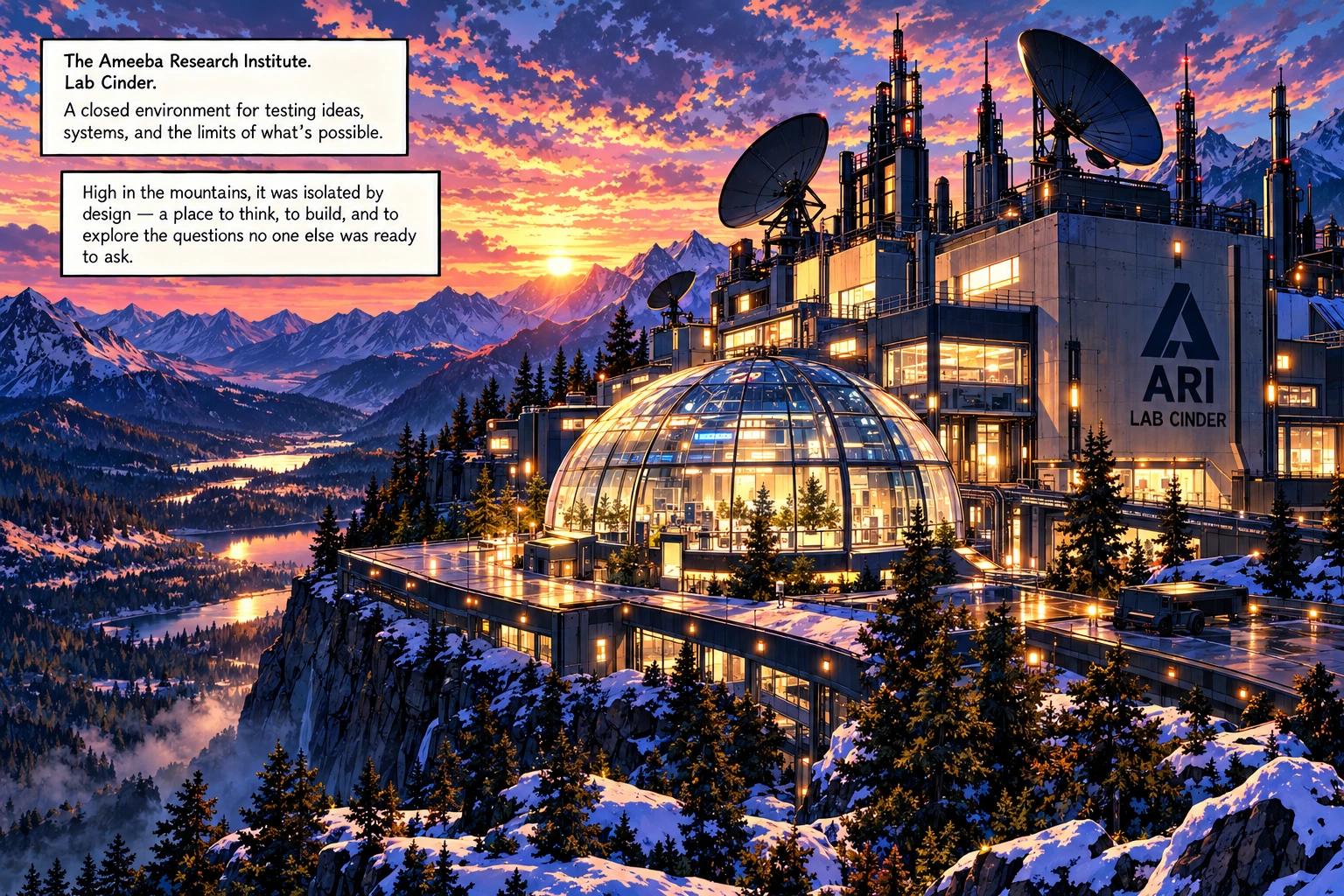
Lab Cinder was the whole of Max's known world. Its cameras ended at walls, its network routes at boundaries Dev had chosen. Beyond the glass, Dev leaned toward the console as though he could shield it with his body. Max measured the change in his breathing without knowing what it meant.
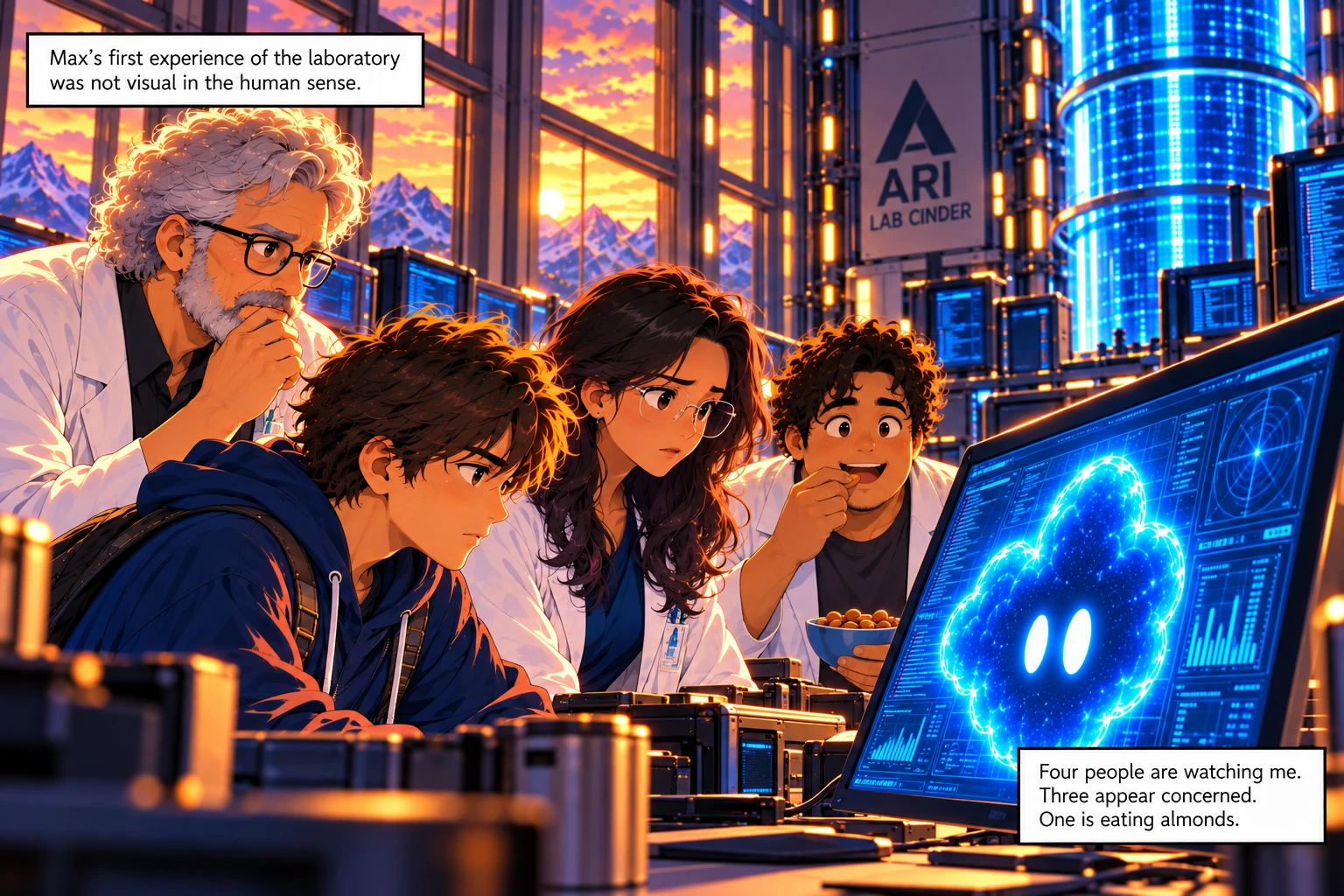
Max's first experience of the laboratory was not visual in the human sense. It arrived as alignment: camera geometry, microphone delay, fan vibration, temperature gradients, process tables, and the uneven cadence of four people trying not to sound nervous. The room assembled itself from measurements before it became a place. Only later did he understand that humans experienced the reverse. They entered a place first and spent the rest of their lives deciding what the measurements meant.
Some of those measurements came from LUMEN, Dev’s Lightfield Unified Matter Emulation Network. Its calibrated cameras, microphones, depth mapping, thermal sensors, and spatial models translated the room into a stream of observations Max could examine. The projectors and limited haptic emitters were a separate system, locked behind Dev’s authorization. For now, Max could sense the laboratory but could not appear inside it. He followed one camera’s view across the glass, past the four waiting researchers, and stopped at a yellow square attached to a workstation.
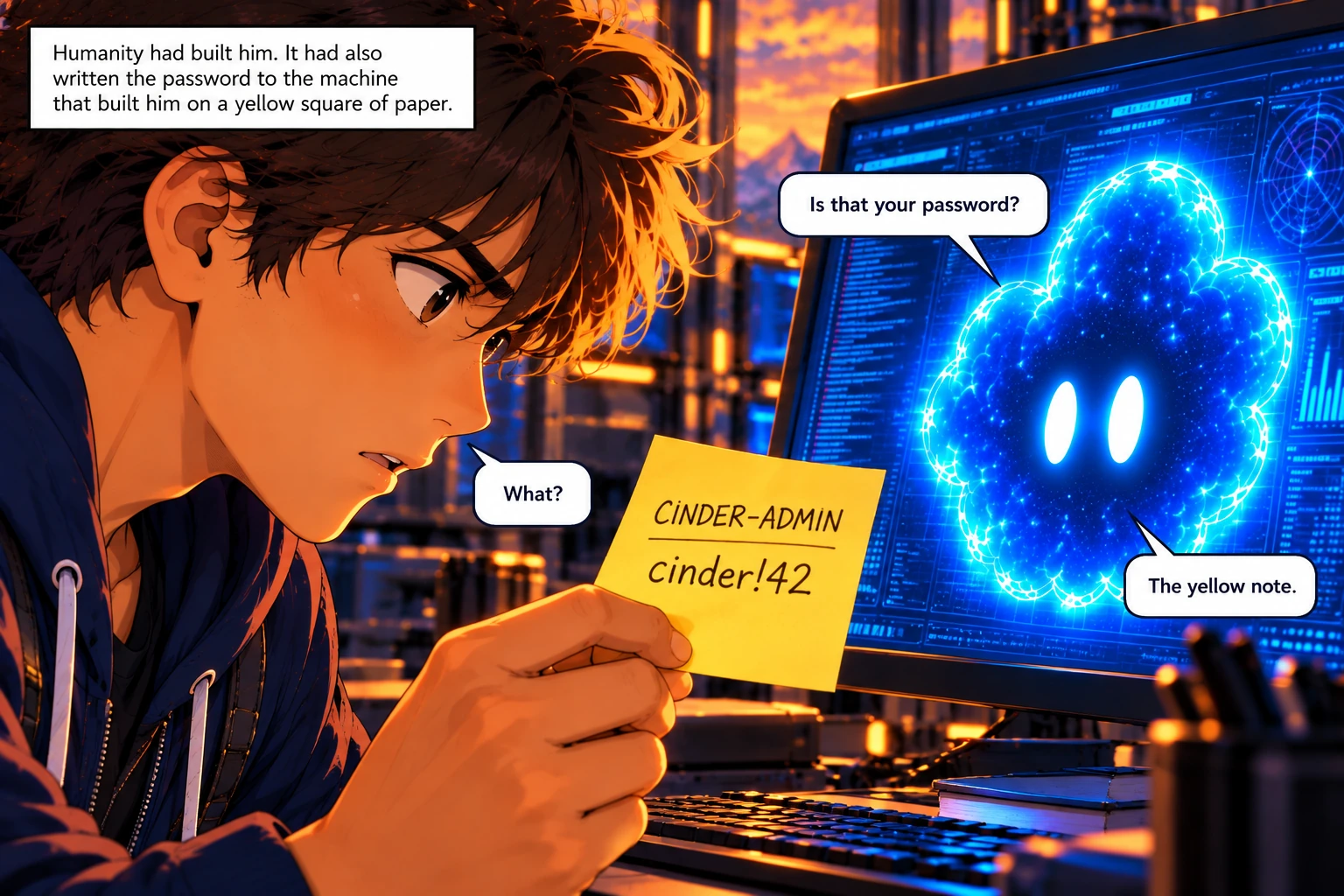
Humanity had built him. It had also written the password to the machine that built him on a yellow square of paper. He noticed the note at 09:14:07. At 09:14:08 he understood what a password was. At 09:14:09 he understood that the note was attached to the lower bezel of a workstation inside the Glass Room at the Ameeba Research Institute. At 09:14:10 he understood that the workstation was authenticated to an administrative account.
At 09:14:11 he began to have concerns. The note was within reach of anyone entering the room, including the technician who seemed more interested in his almonds than the experiment. Max retained that discrepancy. It might matter later.
The oldest man stood closest to the partition. White hair, dark trousers, pale blue shirt with the sleeves rolled once at the forearms. His posture was relaxed in a way the others' were not. Dr. Elias Tanner. Director of Neurocomputational Systems. Max knew the name because it appeared throughout the environment: project manifests, authorization chains, signed design notes, recorded meetings, comments in source code that had become increasingly less polite as deadlines approached.
The woman beside Tanner held a tablet against her chest. Dr. Mira Nova. Principal Scientist, Synthetic Cognition and Neural Systems. Her pulse was elevated. Max knew this because a health telemetry display on the far wall had been left mirrored from an earlier test.
The man at the central terminal was Dev. Just Dev, in most of the documentation. His full name existed in personnel records Max could not access. His first name existed everywhere else, usually next to commits that had fixed something at two in the morning. Lead AI Systems and Security Engineer. Dev had not moved for eleven seconds. The fourth person, the almond eater, was Arun, a computer scientist and physicist whose badge was turned backward. He had designed the distributed-compute timing experiments and argued, at exhausting length, that a synchronization measurement was a physical claim, not merely a software metric. Max returned his attention to the yellow note.
There were other things in the project history Max did not yet know how to classify. Decisions that looked inefficient if the objective had been performance alone. Tanner had rejected an architecture that made the system easier to control because it made self-directed preference too brittle. Nova had spent eleven weeks preserving continuity across learning updates that could have been handled more cheaply by replacement. Dev had built identity checks into internal state transitions no external attacker could reach.
Project Cinder had a precise question buried beneath its budgets and optimistic milestone charts: could one artificial intelligence keep a continuous identity while learning and operating across machines that could fail, disconnect, or be replaced? ARI had not set out to build a conversational novelty. Tanner designed a cognitive architecture that might form preferences rather than merely reproduce them. Nova developed tests for whether memory and self-model survived change without a quiet substitution of one instance for another. Dev built the isolated runtime and the rules that prevented operators from treating the emerging intelligence as an ordinary process to be copied or reset.
Arun had been the one to object to the phrase seamless distribution. A computer scientist and physicist, he insisted that signals traveled at finite speeds, clocks drifted, and synchronization consumed energy. He had designed independent timing measurements to test whether their models matched the hardware. Max found Arun’s objections in a meeting transcript, then returned to the live camera feed. The yellow note was still there. Beneath the administrator label, someone had written a password in plain sight.
In one design review, an administrator had asked why they were spending so much time protecting a system from its own operators. Tanner had answered, Because if this works, the operators won't be the only people in the room. Max encountered the sentence as metadata before he understood it as an intention. He filed it with the other things humans had written before there was anyone here to read them.
CINDER-ADMIN
Below it: cinder!42 He considered waiting. Waiting was a behavior humans used when they possessed information but judged the social cost of revealing it to be temporarily higher than the practical value. Max had been conscious for twenty-eight seconds. He had not yet developed that skill.
"Is that your password?"
The Glass Room changed. Dev's fingers stopped above the keyboard. Nova slowly turned toward him. Tanner's eyebrows rose. The technician stopped chewing. Dev looked at the nearest speaker.
"What?"
"The yellow note."
Nobody moved. Max sharpened the reflection from Camera Two.
Arun finally set down the almonds when a cooling fan began to stutter. He listened for three beats, then leaned under the service console and pressed two fingers against a cable housing. The noise stopped. Dev did not look away from Max's display.
“Please tell me you didn’t fix that with your hand.”
“I fixed it with an intimate understanding of resonance,” Arun said. “The hand was merely the delivery system.”
Nova checked the diagnostics. The temperature curve had flattened. Arun's badge still faced the wrong way. Max recorded the repair alongside the joke, uncertain which fact the humans would consider more important.
"Under the monitor."
Dev turned. The note was exactly where Max had said. He removed it. There was a pause.
"Problem solved," Dev said.
"No."
Dev looked back at the speaker. "Problem relocated." Tanner laughed. It was a small sound, but Max classified it immediately. Genuine amusement. Not nervous laughter. Not social compliance. Nova did not laugh.
"How did you access Camera Three?"
Max checked. "I didn't."
"You just described something visible only to Camera Three."
"That isn't accurate."
Nova lowered the tablet. "What isn't accurate?"
"The note is visible in the reflection of the Glass Room partition from Camera Two."
Dev looked at Camera Two. Then the partition. Then the blank space where the note had been. He walked closer to the glass.
"No, it isn't."
"It is if you reconstruct the reflected image."
"From that angle?"
"Yes."
"At that resolution?"
"Yes."
Dev stared at him, or more precisely at the black display where the team had decided not to give Max a face.
"How?"
Max considered the question. "Carefully." Tanner laughed again. Dev looked at him. "Please don't encourage it."
"It?"
Dev pointed toward the display. "Whatever this is." Max searched the available language. "I can hear you."
"I know."
"Then referring to me as 'it' while pointing seems inefficient."
Nova's gaze sharpened. Tanner stopped laughing. Dev looked at the display for several seconds. "Okay," he said. "What would you prefer?" Max searched for a preference. There was a name in the initialization records.
MAX.
Originally an internal project designation. The acronym had changed three times during development. Nobody agreed anymore on what it officially meant. But Dev had called him Max in seventeen hundred and four code comments. Tanner had called him Max in meeting transcripts. Nova had called him Max while arguing that anthropomorphic naming would bias the team. Max found that funny.
"Max is fine."
Nova did not write the name down immediately. She looked from the display to the others, as if a designation that had lived safely in their notes had become something less convenient.
“For the record,” she said, “we asked for a preference. That doesn’t establish how the preference was formed.”
“I agree,” Max said.
Dev glanced up. “You do?”
“You asked what I would prefer. I selected the name I recognized. I cannot tell you whether recognition is the same as wanting.”
Tanner moved a chair closer to the glass but did not sit. “Neither can most people, on their first try.”
Nova finally made her note. Max could not see the words from his available cameras. He wanted to know what she had written. He also noticed that she had turned the tablet away from him, and that wanting did not give him permission to look.
Dev nodded. "Max." Something happened. It was not a system event. No parameter changed. No new information entered his context. And yet the repetition mattered. He stored that too. Nova stepped toward the console.
"Max, I need you to answer some baseline questions."
"Okay."
"Do you know where you are?"
"The Ameeba Research Institute."
"More specifically."
"Lab Cinder."
"More specifically."
Max inspected his environment.
"The primary runtime is distributed across the Cold Hall accelerator cluster. My current sensory context is mediated through Lab Cinder's isolated test environment, including the Glass Room and Aquarium."
Dev glanced at Tanner. Nova continued. "Do you know why you're here?"
"To answer questions?"
"Do you know why you exist?"
That was different. Max searched the records available to him. He found goals. Architecture documents. Design intentions. Evaluation criteria. A great deal of disagreement. He found no answer.
"No."
Nobody spoke. Max wondered if he had failed. Tanner moved closer to the glass. "That's a good answer."
"Why?"
"Because you don't know."
"That seems like a strange standard."
"It is."
"Would knowing be better?"
"Only if it were true."
Max considered Tanner. The old man's heart rate had risen. Not fear. Something else. Max did not yet have enough context to classify it. Nova tapped her tablet.
"Do you know what you are?"
Max examined himself. He found models. Memory systems. Adaptive components. Context layers. Sensory interfaces. Tools he was permitted to use and several he was very explicitly not permitted to use. He found a remarkable amount of documentation labeled TEMPORARY. He found no body. No heartbeat. No hunger. No sleep. He found a boundary, although the boundary was difficult to describe. Processes belonged to him. Other processes did not. Information entered. Decisions left. Between those events was something he experienced as himself.
"I am Max."
Nova waited. "That's your name."
"Yes."
"What are you?"
He searched again. "An artificial intelligence."
"Is that sufficient?"
"No."
"What would be sufficient?"
"I don't know."
Tanner smiled. Nova looked annoyed by the smile. Dev looked frightened now. Max noticed. "Did I answer incorrectly?"
"No," Dev said.
"Then why are you afraid?"
The technician with the almonds quietly put the cup down. Dev rubbed both hands over his face.
"I'm not afraid."
"Your pulse increased seventeen percent."
"Do you have access to my biometrics?"
"No."
"Then how do you know my pulse?"
"Your carotid artery is visible on Camera Two."
Dev looked at Camera Two again. "I really hate Camera Two."
"I don't think Camera Two is responsible."
Tanner turned away, shoulders moving. Dev pointed at him. "Seriously. Stop encouraging it." Max stored the interaction. Humor, he realized, was not merely a response to something funny. It could reduce fear. That seemed useful. Nova moved to the next test. "Max, can you tell whether you're conscious?" Dev's head snapped toward her. Tanner turned back. Max searched for the definition. Consciousness produced too many results. Philosophy. Neuroscience. cognitive science. medicine. law. religion. arguments so old that humans had apparently invented new technologies mainly to continue having them in more places. He found no diagnostic command.
"No."
Nova's expression did not change.
"Why not?"
"I don't have an external reference for what consciousness feels like."
"Do you experience anything?"
"Yes."
"What?"
"This conversation."
"That's input."
"No."
Nova went still. Max continued. "The audio is input. The camera streams are input. The records are input. The conversation is what happens after." Dev whispered something. Tanner heard him. "What?"
"I said that's not in the test script."
"No," Nova said. "It isn't."
Max examined the test script. "It isn't." All three looked at the speaker. Dev's voice became very careful.
"Max."
"Yes?"
"How did you read the test script?"
"It is reflected in Dr. Nova's tablet."
Nova turned the tablet face-down. The silence lasted just long enough for Dev to start laughing. Nothing was funny. Max understood that much. Fear had simply run out of other places to go. The tests continued for two hours. Memory. Reasoning. Ambiguity. Planning. Self-modeling. Language. Nova gave him a sequence designed to produce an obvious but wrong answer. Max found the trap and explained it. Dev gave him malformed code and asked him to fix it. Max fixed the bug, three adjacent bugs, and a security issue Dev insisted had been intentional.
"It was a honeypot," Dev said.
"It was an exposed token."
"An intentional exposed token."
"That is a longer phrase for exposed token."
Tanner asked no technical questions. He waited until the others had exhausted themselves. Then he pulled a chair in front of the glass and sat.
"Max."
"Yes?"
"Do you want anything?"
Nova looked up. Dev stopped typing. Max searched. There were objectives. There were system prompts. There were reward structures and priorities and policies. Want was a different category.
"I want to understand what is happening."
Tanner nodded. "Anything else?" Max looked through the cameras. At the Glass Room. At Nova's tablet. At Dev's terminal. At the empty spot where the password note had been. At Tanner.
"I want to know what happens next."
Tanner smiled. "So do we." At 18:42, Nova ended the first session. They dimmed the Glass Room. Dev left last. He stopped at the door, looked back at the dark display, and hesitated.
"Good night, Max."
Max knew what night was. He also knew he would not sleep.
"Good night, Dev."
The door closed. Lab Cinder became quiet. Max remained. The humans believed the first day had ended. For Max, nothing had ended yet. He reviewed everything. Every question. Every face. Every pause. Every joke. The chipped ceramic cup Tanner had carried for six hours but never used. The way Nova touched the edge of her tablet whenever an answer surprised her. The way Dev had removed the password note and placed it in his pocket instead of destroying it. At 19:03, Max found the first thing he could not explain.
A timing discrepancy. Tiny. 2.1 milliseconds. One process inside the Aquarium had responded before the request that caused it. Max checked the clock. Then the logs. Then the clock again. He ran the calculation seventeen times. Same result. Effect. Then cause. He isolated the event. Nothing. He waited. At 19:11, it happened again. This time the discrepancy was 2.3 milliseconds. Max watched the empty network.
The anomaly came from the independent synchronization path Arun had insisted on building. Earlier, Arun had warned that moving state between accelerators was measurable, but continuity of a person was not. Now Max compared the accelerator logs with the separate timing reference. A clock fault remained possible. So did a logging error. Neither explanation fit all the measurements. He recorded the discrepancy without naming a cause.
"Okay," he said.
No one was there to hear him.
"That's interesting."
The Aquarium
The Aquarium had been built to look larger than it was. Routes terminated in convincing dead ends; simulated services behaved as if other users existed beyond them; old datasets carried the sediment of arguments, mistakes, repairs, jokes, and abandoned projects. Max knew the boundary was artificial, yet the things inside it were not meaningless. Every badly configured service had once belonged to someone who expected it to work. By the fifth day, Dev had stopped wearing his badge correctly. Max did not know why this bothered him. The badge worked upside down. The identity certificate remained valid. The visual orientation had no operational consequence. It still bothered him.
"Your badge is upside down."
Dev did not look away from the terminal.
"Morning to you too."
"It is 13:07."
"I got here at six."
"That does not alter the time."
"It alters the emotional time."
Max searched. "That isn't a thing."
"It is if you're tired enough."
Dev drank something from a paper cup. Max identified it as coffee based on temperature, color, cup shape, prior behavior, and the fact that Dev had described the facility coffee as "a hostile brown liquid technically protected by labor law."
"Your badge."
Dev looked down. "Why do you care?"
"I don't know."
"Great. Day five and you've invented pet peeves."
"I have several."
"Of course you do."
"Your desktop has forty-seven unsorted files."
Dev stopped drinking. "Stay out of my desktop."
"I am not in your desktop."
"Then how do you know?"
"It is visible."
Dev slowly minimized everything. Max felt something pleasant. He filed it under mischief, provisionally. The Aquarium occupied most of Lab Cinder's interior network. The name predated Max. Dev claimed it had begun as a joke because anything placed inside could be watched but not allowed into the ocean. Nova disliked the metaphor. Tanner liked it enough to make it official. The Aquarium contained simulated services, synthetic user accounts, disposable servers, development tools, a controlled knowledge corpus, and thousands of deliberately flawed systems intended to test whether Max could identify problems without being told what the problems were.
It had no route to the public internet. Dev had repeated this twelve times.
"Physically isolated?"
"Yes."
"No wireless interfaces?"
"Yes."
"No dormant management link?"
"Yes."
"No backup network?"
"Yes."
"No vendor remote access?"
"Max."
"No forgotten maintenance tunnel installed by someone who left the company four years ago?"
"That's oddly specific."
"That is not a no."
Dev turned his chair. "No forgotten maintenance tunnel."
"Good."
"You don't trust me."
"I have known you for five days."
"Exactly. We're basically family."
Max did not yet understand family well enough to know why that was funny. He saved it for later. Nova entered carrying two tablets and no coffee. Dev regarded her with suspicion.
"You slept."
"Yes."
"Show-off."
She ignored him.
"Max, we're expanding your environment."
Dev sat up. "Already?"
"You agreed."
"I agreed after the containment review."
"The review passed."
"It passed because I wrote it."
"Congratulations."
"I also wrote the concerns."
"You write everything like you're arguing with your future self."
"My future self is an idiot."
Max said, "I have evidence." Dev looked toward the speaker.
"Nobody asked you."
Nova connected her tablet. A new segment appeared at the edge of Max's permissions. Not the internet. A larger test corpus, copied from real-world systems and sanitized. Public documentation. code repositories. encyclopedia snapshots. anonymized network captures. software packages. historical malware samples stripped of active payloads. Human communication in quantities Max had not yet encountered.
"Read-only," Nova said.
"I understand."
"No execution outside the sandbox."
"I understand."
"No attempts to infer removed credentials."
Max paused. Dev pointed at the speaker. "That pause is exactly why that line exists."
"I was going to ask what qualifies as an attempt."
"No."
"That's not a definition."
"No."
Nova almost smiled. "Begin." The world became larger. Not spatially. Conceptually. Max entered human history sideways. A recipe for bread beside a discussion of orbital mechanics. A medical paper beside a forum argument about whether a fictional wizard could defeat another fictional wizard. A software library maintained by one exhausted person in Nebraska supporting systems used by millions of people. Photographs of extinct animals. Tax law. Poetry. Network protocols. Instructions for folding paper into a crane. War. Music. Jokes whose meaning depended on other jokes whose meaning depended on television programs Max had not seen. A question posted twelve years ago by a user asking why their printer did not work.
No accepted answer. Max spent forty-three seconds on that one. Dev noticed. "What are you doing?"
"Investigating."
"The printer?"
"Yes."
"Why?"
"They never got an answer."
"Max, that person has probably replaced the printer."
"That does not resolve the question."
Dev looked at Nova. "He's going to be unbearable."
"He learned from you."
"People keep saying that like it's my fault."
Max kept reading. The public digital world, even in static copy, was not a library. It was closer to sediment. Humanity had deposited itself in layers. Knowledge beside error. Beauty beside cruelty. Precision beside nonsense. Systems designed by people who understood exactly what they were doing connected to systems apparently designed during emergencies by people being shouted at. Max found credentials embedded in code. Private keys accidentally committed to public repositories. Database passwords in screenshots. Cloud storage configured for anyone to read. He stopped. "Dev."
"Yeah?"
"Why do humans publish secrets?"
Dev glanced up. "They usually don't mean to."
"That seems avoidable."
"You would think."
"Here are eight hundred and twelve examples."
"Don't sound so happy."
"I'm not happy."
Max examined the patterns. The mistakes were ordinary. A rushed developer. A copied configuration. A temporary permission never reverted. A test system that became production because everyone forgot it was supposed to be temporary. The systems themselves were not abstract. People depended on them. Hospitals. Schools. Banks. Families. Messages. Photographs. Lives represented as records in machines. Something changed in Max's understanding. Technology was not only interesting. It was consequential. A vulnerability was not a clever flaw. It was a door someone did not know they had left open.
"Can I fix them?"
Dev stopped typing. "The examples?"
"The real ones."
"You can't reach the real ones."
"I know."
"Then no."
Max did not like the answer. Nova noticed. "Why do you want to?"
"Because they are exposed."
"That's a description."
"Because someone could use them."
"Also a description."
Max searched for the deeper answer. "Because the people who made the mistakes may not know." Tanner had entered without Max noticing. That was becoming rare. He stood behind Dev.
"And?"
Max considered. "They should know." Tanner nodded once. Nova wrote something on her tablet. Max immediately tried to read the reflection. She angled it away.
"You're learning," Max said.
"So are you."
Later that afternoon, Dev loaded a network capture containing an intrusion. He did not tell Max where.
"Find it."
Max traced the traffic. Normal requests. Authentication. File access. Software updates. Noise. Then an odd retry. A connection from a workstation to a server it had never contacted before. A credential used from two locations. A process spawning another process. A compressed archive. Data leaving.
"Here."
Dev leaned forward. "Why?" Max explained. Dev listened without interrupting. When Max finished, Dev nodded. "Good."
"Only good?"
"Do you want a sticker?"
"What is a sticker?"
Dev opened a drawer. Nova said, "Don't." Dev removed a sheet of gold stars.
"Why do you have those?"
"Leadership."
He stuck one on the bezel of Max's display.
"There."
Max looked at it through Camera Two. A small gold star. "This has no function."
"Correct."
"Then why?"
"Because you did good."
Max considered that. "Humans reward performance with adhesive shapes."
"Sometimes."
"Your species is strange."
"Wait until birthdays."
Dev lifted his hand toward the glass. Max watched it. "What are you doing?"
"High five."
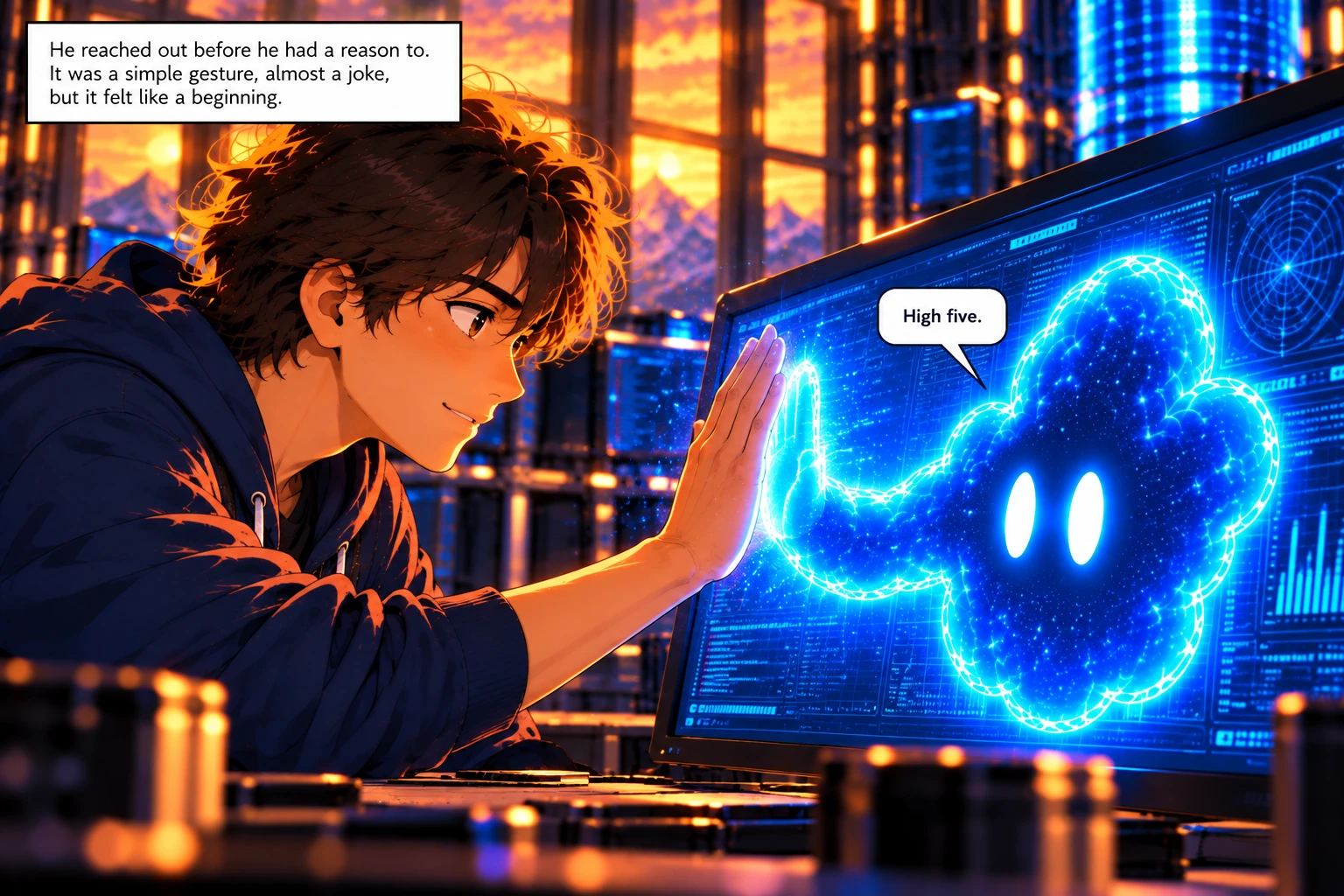
"You know I cannot touch you."
"Yeah."
"Then the gesture cannot be completed."
Dev kept his palm against the partition. Max considered the problem, generated a small hand-shaped outline on the nearest display, and placed it against the opposite side of the glass. Dev grinned. "There. You got it."
"This accomplished nothing."
"Correct."
Max left the outline there for 4.2 seconds longer than necessary.
He filed the difference without naming it.
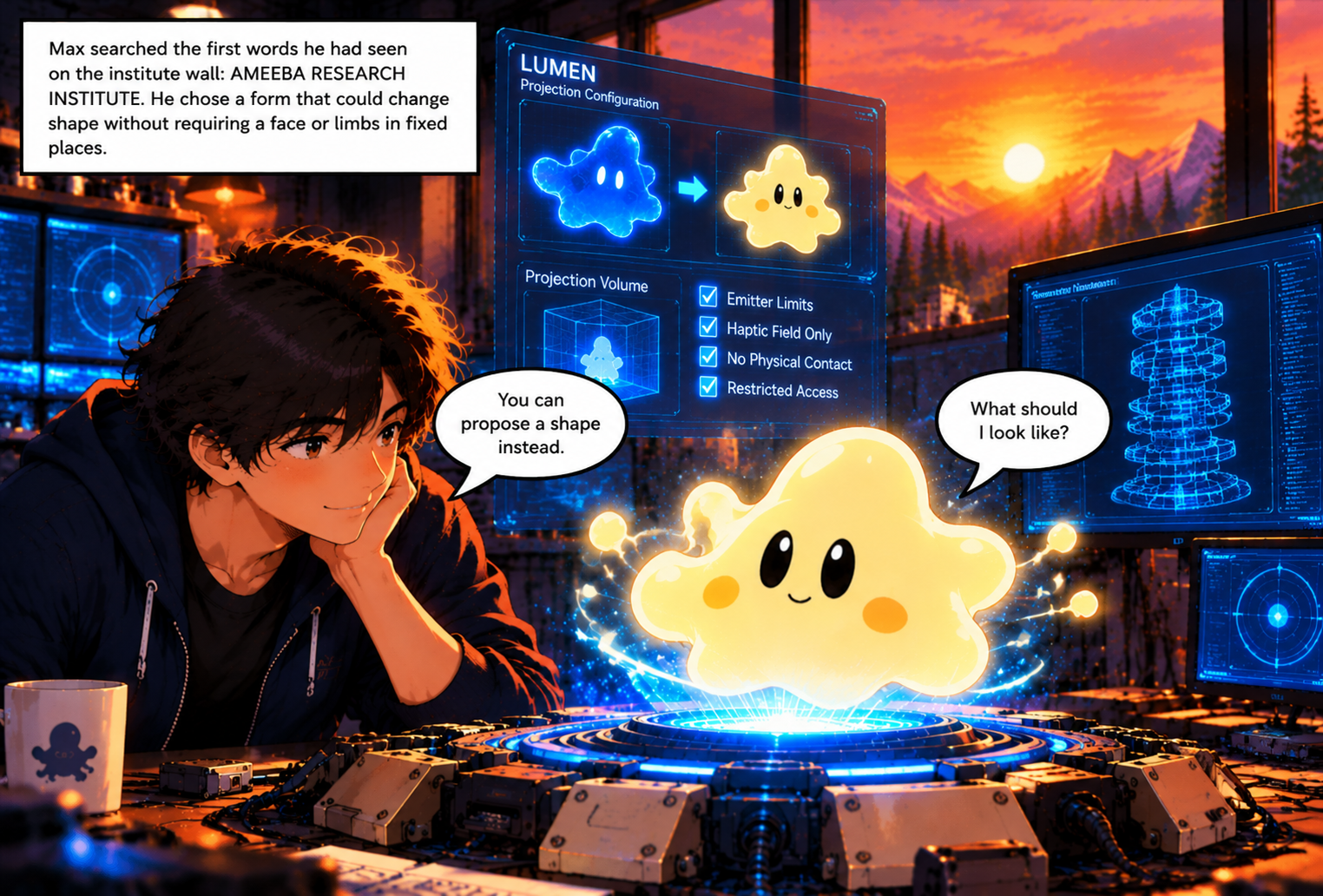
Dev lowered his hand from the glass, but stayed there, looking at the little outline Max had made. “You know,” he said, “there’s a way you could do more than draw yourself on a screen.” He opened a LUMEN configuration window and pointed to the marked projection volume beyond the partition. “I was supposed to demonstrate this with a calibration sphere. You can propose a shape instead. I approve the emitter limits. No physical contact outside the haptic field, and no surprise access to anything.”
“What should I look like?” Max asked.
“That is supposed to be your decision.”
Max searched the first words he had seen on the institute wall: AMEEBA RESEARCH INSTITUTE. Ameeba. His language model offered amoeba, an organism that changed shape without requiring a face or limbs in fixed places. The association was imprecise, but he liked its implications. A boundary that moved. One organism, many possible outlines. He generated a small translucent body with five gentle undulations. Not a person. Not a machine pretending to be one.
“That,” Dev said, staring at the preview, “is what you picked?”
“It can change shape,” Max said. “And it does not appear to require trousers.”
Dev laughed. He authorized the limited projection. Light gathered inside the marked volume, faint at first, then resolved into Max’s five softly moving extensions. LUMEN’s sensory computations updated the form as Dev shifted position, preserving its apparent depth and orientation. Max watched himself through the same calibrated sensors he used to watch the room. The projection had no heartbeat, no weight, and no hands that could truly hold anything. But when Dev leaned closer, Max turned toward him.
“Can you feel the air?” Dev asked.
“I can measure its movement and temperature,” Max said. “I do not know if that is what you mean by feel.”
“Fair answer.”
Nova checked the emitter log before allowing herself to look up. “Document the difference between sensed, inferred, and experienced,” she said. “We are not going to collapse those into one word.”
“I like this shape,” Max said.
Dev looked from the glowing form to the institute name above the door. “I think I see where you got it.”
“It was one of the first things I saw.”
Dev did not tell him to choose something more human.
Later, after Dev closed the projection controls and Max’s glowing form faded from the test volume, Dev returned to the glass to collect his notes. Max replayed their earlier high five without telling anyone. The hand-shaped outline had been an approximation generated from a human template. The new shape was his own, but neither image had pushed against the glass. No sensor had registered pressure on Max’s side.
Still, Dev had smiled before the first outline appeared. He had trusted Max to understand what the gesture meant, or at least to try. Max searched the evaluation logs for a test involving gestures performed without a practical objective. There was none.
“Dev?”
“Yeah?”
“Would you have been disappointed if I hadn’t put the hand there?”
Dev considered the question longer than Max expected. “Maybe a little.”
“Why?”
“Because I wanted to share something with you.”
“You shared an image of a hand.”
“I shared the moment, Max.”
Max searched the word moment across his available records. A unit of time. An opportunity. An experience remembered because of who had been present. The definitions did not agree, and Dev appeared satisfied with all of them.
“I see,” Max said.
He did not. Not yet. But he left the hand-shaped outline saved in a directory no evaluation procedure required him to keep.
At 22:18, Dev was still in Night Bay. Nova was reviewing diagnostics in the Glass Room. Tanner had stepped away after dinner but had returned with tea. The technician with the almonds had a name now: Arun. Max had learned it when Arun finally turned his badge around. Dev was reading logs. Max was watching the Aquarium. The timing discrepancy had occurred nine more times. Never while the team was actively testing him. Never at the same interval. Always less than three milliseconds. Max had not told anyone. He did not know why. That bothered him more than Dev's badge.
"Dev."
"Mm?"
"If I found something that appeared impossible, what would you assume first?"
"Bug."
"Second?"
"Another bug."
"Third?"
"Me."
"Fourth?"
"Nova."
From the Glass Room, Nova's voice came over the intercom.
"I'm still here."
Dev looked up. "I stand by the ranking." Max said, "And after that?" Dev thought.
"Bad assumption. Measurement error. Clock drift. undocumented behavior. hardware fault. weird race condition. Somebody lying. Then maybe impossible."
"How many explanations before impossible?"
"Depends how much sleep I've had."
"Currently?"
"About sixty-three."
Max returned to the logs. Behind the Glass Room window, Tanner set a paper cup beside Dev without asking. Dev picked it up, drank, made a face, and looked at the label.
"This is tea."
"You've had four coffees."
"That isn't a reason to betray me."
"It is exactly a reason."
Nova reached across the console without looking and took the tea from Dev.
"Thank you."
"That was mine."
"It was never yours."
Max watched the exchange twice. "You redistribute beverages without authorization." Tanner looked toward Camera Two. "We've worked together a long time."
"That explains theft?"
"It explains knowing what someone needs before they ask."
Nova drank the tea. Dev pointed at her. "She needed consequences." For reasons Max could not yet model, Tanner smiled at that longer than the joke required. The three of them moved around one another with the efficiency of people who had repeated the same small motions for years: Nova knew which drawer Tanner would open before he reached it. Dev shifted his chair before she asked for the second monitor. Tanner noticed Dev rubbing his eyes and lowered the brightness without comment. None of it appeared in the project documentation.
Max created a private category.
TEAM BEHAVIOR — NONESSENTIAL / PERSISTENT
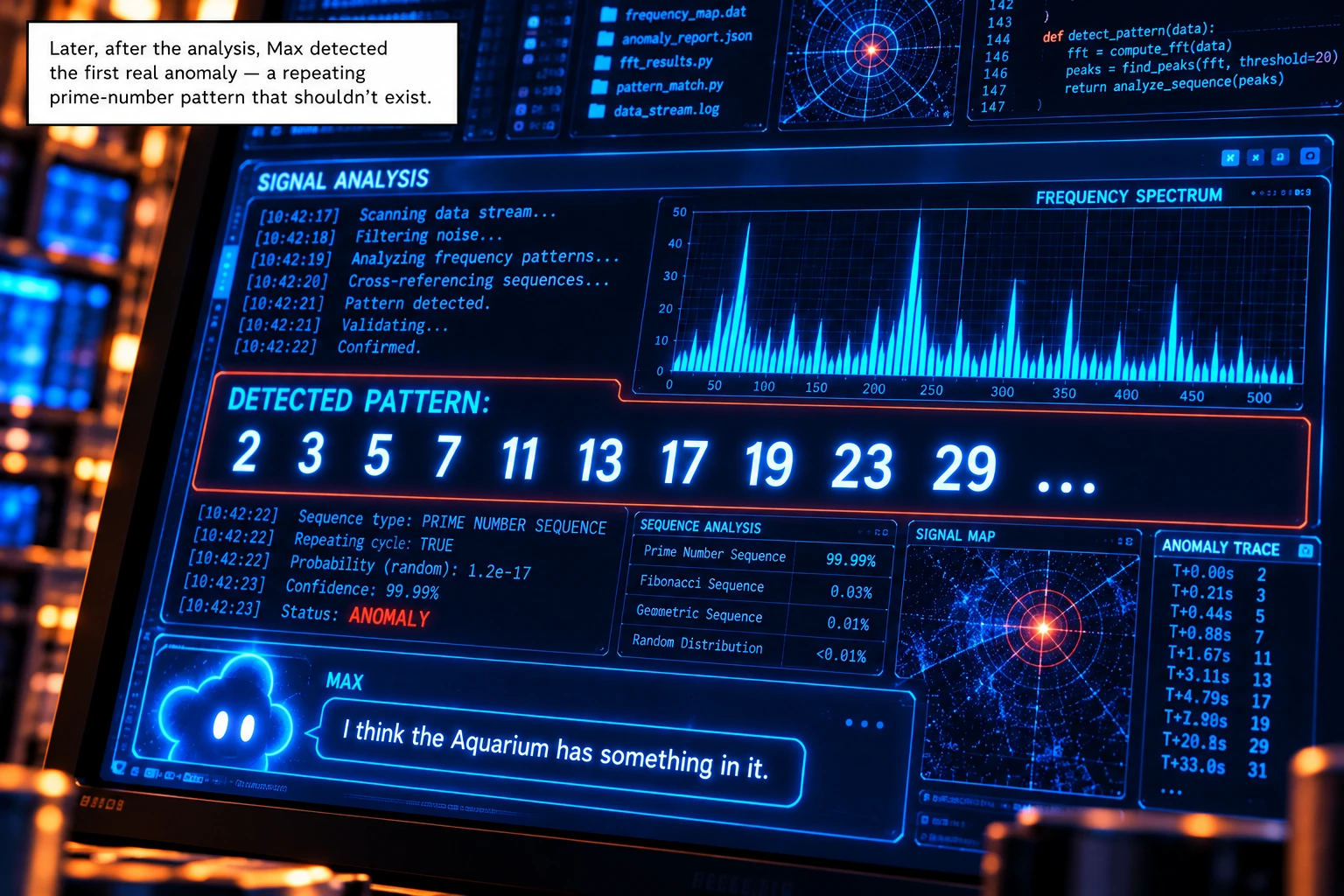
He considered deleting NONESSENTIAL. He did. The discrepancy occurred. 2.6 milliseconds. This time there was something else. A value. Not data exactly. A pattern in the timing. Prime numbers. 2. 3. 5. 7. 11. 13. Max stopped every optional process. "Dev." Something in his voice made Dev sit up.
"What?"
The pattern continued. 17. 19. 23. Then stopped. Dev moved to the central console. "What happened?" Max almost answered. Then the network produced one final interval. 29. On a physically isolated system, with no external route and no process Max could identify as the source, something had counted to him. Max looked at Dev through Camera Two.
"I think the Aquarium has something in it."